South Africa although there is a slow-moving trend towards a
more equitable balance. “One directional trade isn’t good for
anybody,” she says. “If a truck is coming back to South Africa
empty, it is bad for the environment, it snarls up the border
crossing and it makes prices higher as costs have to reflect both
legs of the journey rather than just one leg.”
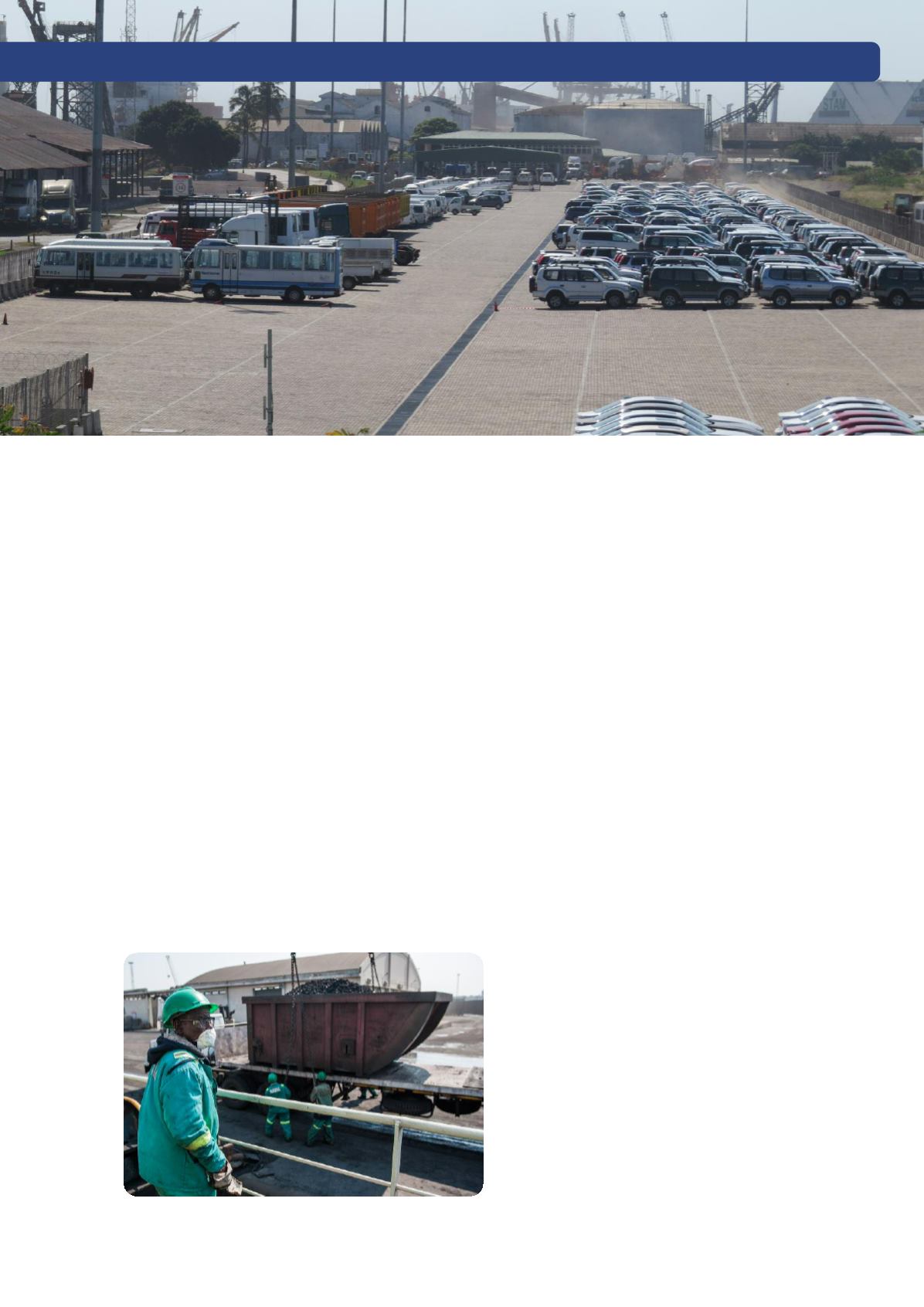
Developments at the car terminal in Port Maputo are an
indication of the possibility of a greater balance to come.
Expansion during 2013 is already facilitating the movement of
South African-made luxury vehicles to markets in the Far East,
while Indian manufacturers Mahindra and Tata have greater
opportunities to bring vehicles into Mozambique and the
surrounding markets. With 4,158 parking bays and throughput
for 150,000 cars annually, there is even capacity to import
vehicles for Mozambique’s flourishing second-hand car market.
MCLI will also continue to promote the need for better
infrastructure in Swaziland, which desperately needs to be
integrated more fully into the corridor. “It will help deal with
trade and logistics issues in the country,” says Mommen. “And
that in turn will support investment in the country – so it’s a
real win-win for Swaziland.”
An example of the opportunities on offer is the booming trade
in iron ore. One of Port Maputo’s biggest clients is Salgaocar,
which is rehabilitating the Hematite waste dumps at the “Old
Ngwenya” Mine in Swaziland. The company has plans to extract
20 million tons of Hematite over a seven-year concession, the
majority of which will be exported to China through Port Maputo.
A Human Story
Ultimately, notes Mommen, MCLI’s mission to add value and
provide new opportunities for all stakeholders along the Maputo
Corridor remains unchanged.
“There is a human side to this story too,” the MCLI CEO
emphasises. “MCLI can bring benefits to the communities along
the Maputo Corridor. Komatipoort is doing a feasibility study on
setting up a Special Economic Zone, for example. It has a strategic
location on the Maputo Corridor and would create jobs and
business. MCLI will continue to encourage this kind of initiative.”
MCLI will further efforts to boost tourism as well. This is a
growing sector that will be vital to the Mozambican economy in
the future.
It will boost South Africa and Swaziland tourism too as people
look to incorporate relatively close sites such as Kruger National
Park into their itineraries. Event tourism – hosting conferences
and major exhibitions – is another exciting prospect.
“MCLI has got through a lot of work in its 10 years of
existence,” notes Mommen. “And that has brought enormous
change and prosperity not only to the companies using the
Maputo Corridor but also to all industry sectors and
communities affected by the corridor.
“But we are not concerned with looking back,” she concludes.
“There is a lot of work still to do and we are focusing on the next
10 years and achieving the results we need for our members
and for the greater good. We believe that the best way of
achieving this vision is to restructure into a PPP so we are able
to partner more effectively with government, use the valuable
private sector expertise to influence goverment policy, and to
drive these necessary changes. It is a challenge, but it is one we
are ready for and one that will provide results.”
l
11
Maputo Corridor Logistics Initiative
Developments at the car terminal in Port
Maputo are an indication of the great
potential of the Corridor.
Inside MCLI


